Auto logout in seconds.
Continue Logout
Despite the increasing demand for behavioral health treatment in primary care and the ED, many providers are ill-equipped. In fact, 60% of visits resulting in a mental health diagnosis are made to a primary care provider (PCP). However, behavioral health is only one of the many issues PCPs treat and their assessment and treatments are inconsistent. And one in eight ED visits is related to a mental health or substance misuse issue. However, only 17% of ED physicians say they have access to an on-call mental health professional.
Just released: Your behavioral health access playbook
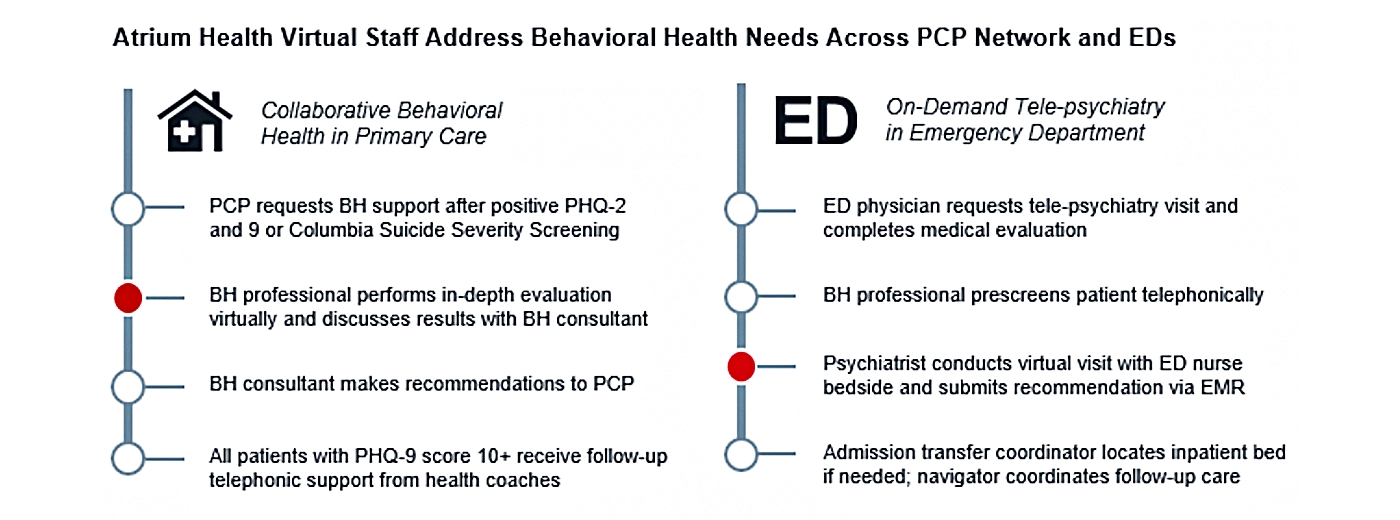
Looking to expand behavioral health access across the state of North Carolina at scale, Atrium Health established a centralized tele-mental health service unit in 2014. The unit virtually links the health system's 28 primary care offices and 22 EDs with behavioral health experts. The staff includes social workers, counselors, and health coaches—all deployed top-of-license to maximize psychiatrists' time.

How a virtual unit can expand primary care and ED behavioral health capabilities
Collaborative behavioral health care for PCPs
Since primary care patients are already a captive audience with unmet needs, most health systems need a strategy to equip PCPs to manage low-to-moderate behavioral health needs at a minimum. All primary care patients are screened for behavioral health needs. Patients who screen positive have a virtual visit with a licensed counselor or clinical social worker. This counselor or social worker then consults with the psychiatrist, who makes care recommendations to the PCP.
A health coach then follows up with the patient via phone for goal-setting, motivational interviewing, and community resource connection. A pre/post-intervention analysis revealed a 45% relative decrease in depression and anxiety symptoms and 27% decrease in avoidable hospitalizations, saving the system $78K.
On-demand telepsychiatry in the ED
When a patient presents to the ED with a psychiatric crisis, a licensed counselor or clinical social worker performs a telephonic prescreen and shares the results with the psychiatrist. The psychiatrist then conducts the virtual visit and submits treatment recommendations to the ED staff through the EMR (e.g., transfer to inpatient bed).
Telepsychiatry services helped Atrium Health improve ED throughput. Even though ED volume surged 37% between 2015 and 2017, median ED length of stay decreased by about 2.5 hours.

Don't miss out on the latest Advisory Board insights
Create your free account to access 1 resource, including the latest research and webinars.
Want access without creating an account?
You have 1 free members-only resource remaining this month.
1 free members-only resources remaining
1 free members-only resources remaining
You've reached your limit of free insights
Become a member to access all of Advisory Board's resources, events, and experts
Never miss out on the latest innovative health care content tailored to you.
Benefits include:
Unlimited access to research and resources
Member-only access to events and trainings
Expert-led consultation and facilitation
The latest content delivered to your inbox
You've reached your limit of free insights
Become a member to access all of Advisory Board's resources, events, and experts
Never miss out on the latest innovative health care content tailored to you.
Benefits include:
Unlimited access to research and resources
Member-only access to events and trainings
Expert-led consultation and facilitation
The latest content delivered to your inbox
This content is available through your Curated Research partnership with Advisory Board. Click on ‘view this resource’ to read the full piece
Email ask@advisory.com to learn more
Click on ‘Become a Member’ to learn about the benefits of a Full-Access partnership with Advisory Board
Never miss out on the latest innovative health care content tailored to you.
Benefits Include:
Unlimited access to research and resources
Member-only access to events and trainings
Expert-led consultation and facilitation
The latest content delivered to your inbox
This is for members only. Learn more.
Click on ‘Become a Member’ to learn about the benefits of a Full-Access partnership with Advisory Board
Never miss out on the latest innovative health care content tailored to you.
Benefits Include:
Unlimited access to research and resources
Member-only access to events and trainings
Expert-led consultation and facilitation
The latest content delivered to your inbox