Auto logout in seconds.
Continue Logout
There are three common misconceptions about hospital/post-acute collaboration regarding how partnerships should be structured, who can start them, and how they should operate.
Preferred provider networks are the only way to achieve cross-continuum alignment.
Often, when hospitals and post-acute providers discuss cross-continuum partnership, they are referring to preferred provider networks. While networks are a popular model of partnership, they are not the only option. Providers should do their due diligence to explore all potential structures, from affiliation agreements to post-acute asset ownership.
Hospitals should be in the driver's seat of partnership initiatives.
Common partnership structures like preferred provider networks are hospital-based and typically initiated by hospitals. Additionally, hospitals tend to have the upper hand due to their size, influence, and position as a referral source. Because of this hospitals may take the lead on cross-continuum partnership, leaving post-acute providers feeling like they don’t have a voice. However, partnership should be equitable to both types of providers, which should be reflected in their leadership, goals and partnership initiatives.
Once built, partnerships are self-sustaining.
After being formed, partnerships often fall short of expectations because providers do not take an active role. Partnership often consists of two main elements: creating a preferred provider list and holding quarterly meetings for data sharing. However, true partnership does not end there. Providers must actively work to promote in-network utilization and create quality improvement initiatives to achieve the goals of the network.
Partnerships are most effective when providers carefully decide on the model of partnership, lead the partnership collaboratively, and play an active role in achieving shared goals.
1. Different partnership options are appropriate for different situations.
There are three major types of partnership which differ by level of financial commitment and level of control over outcomes: joint quality improvement, strategic contracting and, post-acute asset operation. The appropriate type of partnership varies depending on the health system and post-acute provider’s outcomes goals and desired level of financial commitment.
2. Partnerships are most effective when hospitals and post-acute providers lead collaboratively.
To achieve the desired results from partnership, providers must align themselves on shared goals, and actively work towards them. Additionally, providers should leverage the limited time spent together to not just focus on data sharing, but to brainstorm and troubleshoot ideas for cross-continuum initiatives collaboratively.
3. Partnership requires active maintenance to realize full potential.
To get the most out of partnerships like preferred provider networks, providers must engage in cross-continuum quality improvement initiatives to meet shared goals. Additionally, a high proportion of volumes must go to in-network providers. If few patients receive care from preferred providers, the network’s investments in care improvement are wasted, making both these elements key to a successful partnership.
To get the most out of their partnerships, hospitals and post-acute providers should ensure they are not limited in their views on partnership models, who can initiate partnerships, and the types of programming partnership consist of.
To do so, hospital and post-acute leaders should consider the following elements of hospital/post-acute partnership.
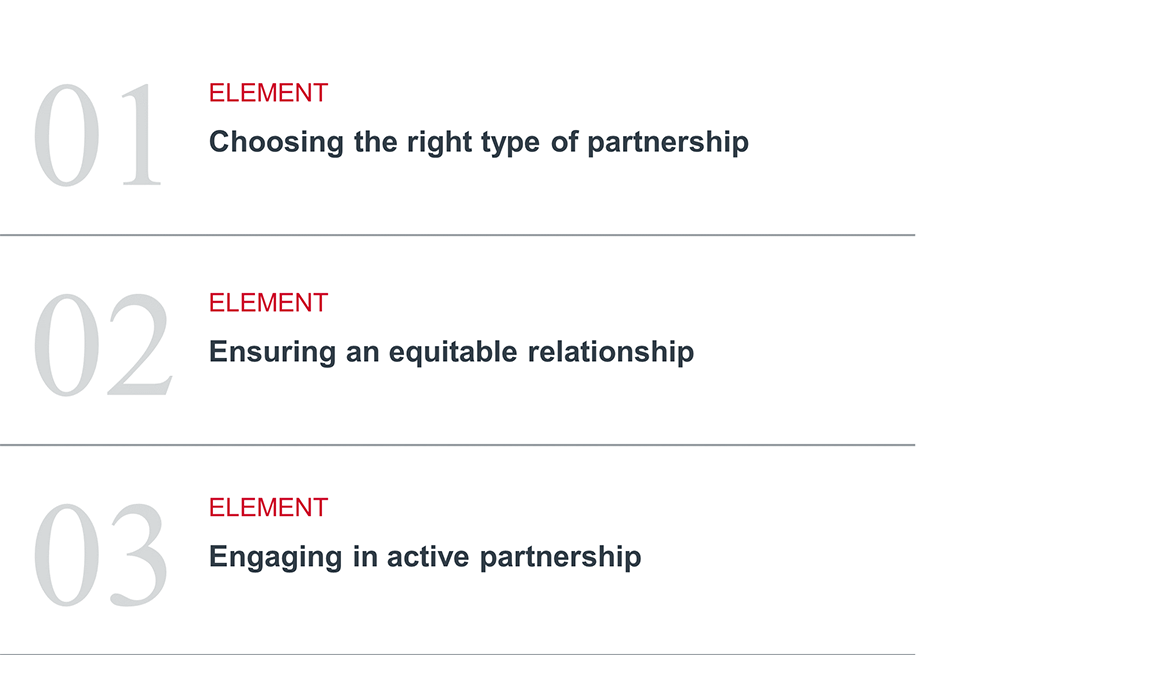
There are two steps to choosing the right type of hospital/post-acute partnership for your organization.
1. Identify your organization’s goals
Creating a partnership is not a goal in and of itself—it is a tool to help health systems and post-acute providers achieve their quality, efficiency, and care coordination goals. Both acute and post-acute providers looking to start partnerships should examine their current goals, and ask themselves the following questions:
- Is my organization taking on episodic or population health risk?
- Is caring for a specific patient population key to my organization’s strategy?
- Does my organization own or have a joint venture with any post-acute providers?
- How much financial investment and human capital commitment is my organization willing to put into partnership?
Understanding what your organization would like to accomplish with a cross-continuum strategy is critical for forming successful hospital/post-acute partnerships. This enables providers to be better informed about the types of partnership models that make the most sense to pursue.
2. Explore partnership options
Partnerships may take many forms, such as preferred provider networks, pay-for-performance contracting, and joint ventures. Preferred provider networks are popular, because they require little financial investment as compared to other vehicles for collaboration. That said, before creating a network it is important to do your due diligence to ensure a network is the best option for your health system’s goals.
When determining which type of acute/post-acute partnership would best suit their organization’s goal, it is important to consider the amount of financial and human capital commitment involved. While greater commitment generally means more work, it also generally means your organization will have the opportunity to more directly impact on results. View the below graphic to understand partnership options based on commitment level, as well as the pros and cons of each type of partnership.

Only your organization can determine which type of partnership will work best to achieve your goals, so take the time to understand the options. For further reading on this topic, please see Post-Acute Partnership Options for Health Systems.
Hospital/post-acute partnership can be mutually beneficial, but if post-acute providers’ perspectives are not included in the partnership strategy, success becomes more challenging. Post-acute voices should be heard when establishing goals for the partnership and setting the agenda of meetings.
Establish and act on shared goals
Partnerships are often formed with the purpose of improving key metrics under accountable care, like lowering length of stay and reducing readmissions. These goals should be agreed upon by all members of the partnership, so all parties are motivated to achieve them. To view a list of common partnership goals, the steps to achieve them, and implementation guidance, see The Hospital/Post-Acute Partnership Goals Picklist.
Effectively run partnership meetings.
Regular meetings between hospital and preferred provider network participants are critical to developing and acting on network performance improvement goals. However, these meetings are often focused on data sharing and can be unengaging, or feel one-sided if the hospital controls thwqe agenda and the discussion. While data-sharing is important, the primary goal of the sessions should be to leverage the fact that multiple key stakeholders are in the room together. They are a prime time for conversation, brainstorming, and debate around partnership initiatives. For further guidance on maximizing shared time during network meetings, see the Effectively Using Preferred Provider Network Meetings.
Partnerships must become equitable spaces for acute and post-acute providers alike. A partnership lacking commitment to true and ongoing collaboration will not succeed in overcoming common challenges and achieving shared goals.
Establishing a hospital/post-acute partnership is only the first step in achieving shared goals. Both in-network utilization and cross-continuum quality improvement are essential elements of an active and successful hospital/post-acute partnership. Neither element works without the other, so it is imperative to execute on both.
Improve in-network utilization
They key to deriving value from a post-acute network is the ability to drive in-network utilization. Generally, networks fail not because of a lack of investment in quality improvement, but because they do not drive enough volumes to their in-network providers. Thus, systems must identify opportunities to increase the share of patients who choose in-network providers. To view the five steps to engage your entire organization in supporting in-network utilization, see The Guide to Promoting In-Network Utilization.
Sustain cross-continuum quality improvement
The primary goal of acute/post-acute partnership is the ability to improve clinical quality across settings. To do so, partners should focus on one or two shared goals at a time, and use network meetings to review relevant data points and discuss possible solutions as a group. Then, a committee of representatives from across the partnership should be dedicated to the decided upon quality improvement initiative. This smaller committee should meet more frequently than the entire group, as needed. Examples of cross-continuum initiatives, as well as operational guidance, can be found The Hospital/Post-Acute Partnership Goals Picklist. Additionally, The Post-Acute Care Clinical Quality Compendium features implementation guidance for post-acute clinical quality improvement programs. Finally, view Effectively Using Preferred Provider Network Meetings for advice on maximizing time spent together as an entire network.
Make partnership a priority for your organization. Partnerships are only as effective as the initiatives that make them up, so providers should ensure partnerships are working towards shared goals and productively using meeting time.
The elements outlined in this document are intended to support your organization as you develop and maintain cross-continuum partnership.
Beyond the factors discussed here, to be most effective, partnerships must be supported by the broader organizations’ leadership. A leadership team that is aligned with goals of the partnership will help the partnership sustain success. Additionally, when new priorities arise, an aligned leadership team will ensure partnership activities are not put on the back burner.
Partnerships are what you make them. They can vary in financial and human capital commitment, who initiates them, and the activities done to maintain them. All these factors can affect the results of the partnership. What’s most important to remember is that partnership is not a one-size-fits all solution, and providers have the power to shape their partnerships to meet their needs.

Posted on March 08, 2021
Updated on January 12, 2024

Don't miss out on the latest Advisory Board insights
Create your free account to access 1 resource, including the latest research and webinars.
Want access without creating an account?
You have 1 free members-only resource remaining this month.
1 free members-only resources remaining
1 free members-only resources remaining
You've reached your limit of free insights
Become a member to access all of Advisory Board's resources, events, and experts
Never miss out on the latest innovative health care content tailored to you.
Benefits include:
Unlimited access to research and resources
Member-only access to events and trainings
Expert-led consultation and facilitation
The latest content delivered to your inbox
You've reached your limit of free insights
Become a member to access all of Advisory Board's resources, events, and experts
Never miss out on the latest innovative health care content tailored to you.
Benefits include:
Unlimited access to research and resources
Member-only access to events and trainings
Expert-led consultation and facilitation
The latest content delivered to your inbox
This content is available through your Curated Research partnership with Advisory Board. Click on ‘view this resource’ to read the full piece
Email ask@advisory.com to learn more
Click on ‘Become a Member’ to learn about the benefits of a Full-Access partnership with Advisory Board
Never miss out on the latest innovative health care content tailored to you.
Benefits Include:
Unlimited access to research and resources
Member-only access to events and trainings
Expert-led consultation and facilitation
The latest content delivered to your inbox
This is for members only. Learn more.
Click on ‘Become a Member’ to learn about the benefits of a Full-Access partnership with Advisory Board
Never miss out on the latest innovative health care content tailored to you.
Benefits Include:
Unlimited access to research and resources
Member-only access to events and trainings
Expert-led consultation and facilitation
The latest content delivered to your inbox