Auto logout in seconds.
Continue Logout
Overview
The challenge
Covid-19 posed challenges that required agile and dynamic solutions. It contributed to staff burnout and general workforce shortages. Social-distancing mandates also increased demands for alternate care access points. The challenges of Covid-19 were made even more difficult for those without a network of care sites to share resources and meet shifting patient demands.
The organization
Venice Medicine (pseudonym) is an academic medical center in the South. They have two cardiovascular outreach centers that were built to draw patients from a competitive, outer market.
The approach
Venice found that while outreach centers were beneficial to stay competitive and protect referral streams, a connected network strategy could help them solve fragmentation and efficiency concerns as a system.
Venice’s outreach centers have employed point solutions to tackle various Covid-19 challenges. This includes expanding telemedicine as well as work from home capabilities for some staff. Once telemedicine was established, Venice’s outreach centers were able to offer flexible scheduling for physicians taking virtual visits. To incorporate these point solutions into a larger service strategy, Venice then left their management company partnerships, and integrated outreach center protocols with their Heart & Vascular Center.
The result
Venice’s response has streamlined patient care, cutting out unnecessary touchpoints and referral queues. Patient and physician satisfaction has led Venice to plan for additional technology use and alignment of their service line across care sites.
As a result of the pandemic, and the quick responses it required, Venice has learned that the best thing you can do to succeed in the outpatient space is giving yourself the gift of flexibility.
Venice’s quick response in the early days of the pandemic offered its patients expanded access to efficient, streamlined care even beyond Covid-19. Venice has streamlined patient care, reducing unnecessary touchpoints and referral queues—and thus, have further cemented the value of their early tactics.
Benefits of Venice’s approach
- Improved physician satisfaction
- Improved patient satisfaction and access
- Service line alignment across care sites
Patient and physician satisfaction has led Venice to plan for additional technology use and streamlining their service line model.
The three strategies
In the years following the start of the pandemic, Venice Medicine has established and refined three strategies to enhance the flexibility of their outreach centers:
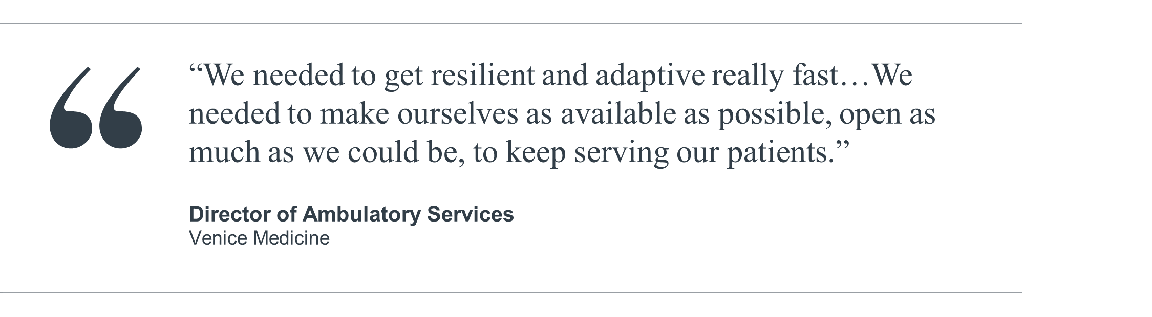
During the early days of the pandemic, Venice shifted their focus to balance the growing demands of their patients with the needs and safety of their staff. As a result, Venice identified two immediate needs. The first was to respond to increasing need for additional care sites, and the second was to address staff burnout.
Venice addressed the first need by quickly expanding its telemedicine capabilities. Telemedicine had been at its infancy at Venice medicine at the start of the pandemic. They already partnered with a telemedicine group but needed to expand to meet urgent, Covid-19 demands. This included building infrastructure and privacy protocols for the technology.
To address staff burnout, Venice expanded its work from home capabilities by providing laptops to nurses, human resources and front desk staff. While this allowed Venice to increase access amid capacity constraints and social distancing requirements, it also led to stacked meetings and visits. To prevent this new reality from contributing to burnout, Venice is making plans to more appropriately limit and distribute meetings for staff.
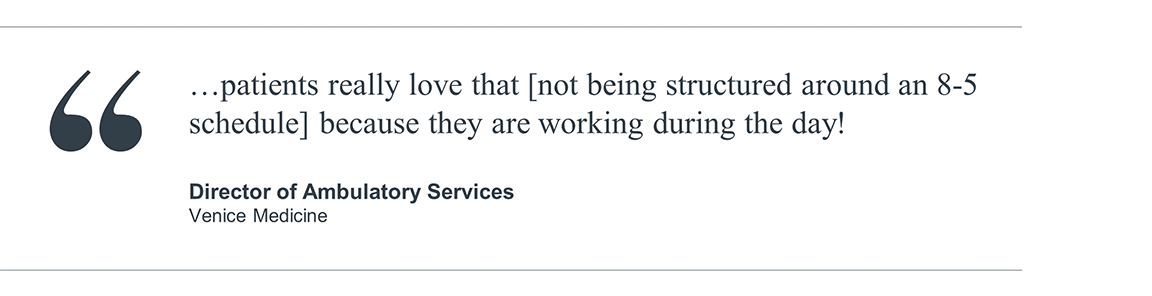
Building telemedicine capabilities expanded where care could be accessed. Given the flexible nature of virtual care, it also changed when care could be accessed. To balance patient and provider needs, Venice allowed physicians to choose their telemedicine hours even if those were outside of regular clinic hours. This additional physician flexibility reduced physician burnout and increased staff engagement.
For Venice, it started with one physician with a difficult schedule. Rather than extending clinic hours, Venice found that having telemedicine capabilities allowed this physician to choose their own hours. And once the benefits of doing so for one physician were clear, “it was important to try to determine what made sense for each provider…Getting that right mix of in person and virtual was challenging for each individual provider.”
Although flexible scheduling began as a way to maintain physician satisfaction, patients have benefited from extended hours as well. Patients are drawn to Venice from the competitive areas surrounding their outreach centers, given Venice’s reputation for quality and compassionate care. Flexible hours is a further way to draw patients in and keep them happy. One challenge that Venice still grapples with is communicating to patients that this flexibility exists.
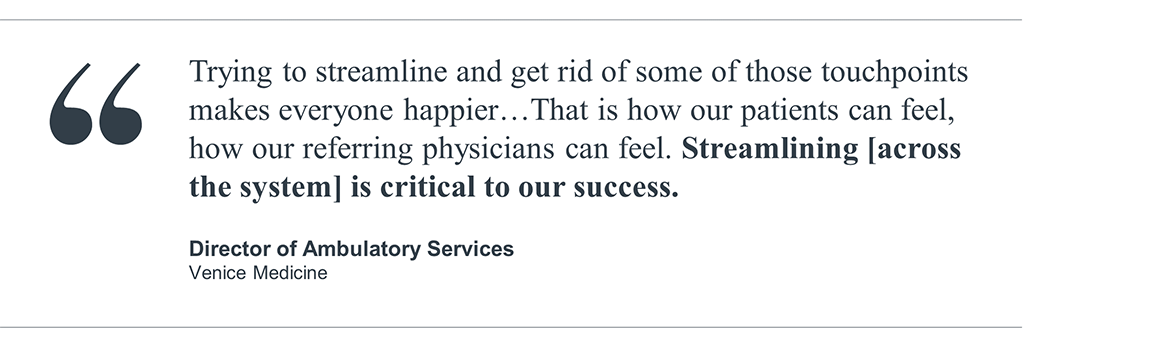
Covid-19 required a rapid response, but Venice decided to make the most of its new investments by reflecting and iterating on its solutions. Through this process, it became clear that Venice needed a strong cardiovascular service line rooted within its broader, ambulatory network strategy.
In recent years, Venice took on the challenge of centralizing the cardiovascular service line. They terminated their management company partnership in favor of integrating the service line processes at the medical center. As a result, cardiovascular specialists have more defined process guidelines and the support of a co-located pharmacy tech for prior authorization. While day-to-day decisions are less autonomous now that they are decided at the system level, Venice feels the pros outweigh the cons.

Don't miss out on the latest Advisory Board insights
Create your free account to access 1 resource, including the latest research and webinars.
Want access without creating an account?
You have 1 free members-only resource remaining this month.
1 free members-only resources remaining
1 free members-only resources remaining
You've reached your limit of free insights
Become a member to access all of Advisory Board's resources, events, and experts
Never miss out on the latest innovative health care content tailored to you.
Benefits include:
Unlimited access to research and resources
Member-only access to events and trainings
Expert-led consultation and facilitation
The latest content delivered to your inbox
You've reached your limit of free insights
Become a member to access all of Advisory Board's resources, events, and experts
Never miss out on the latest innovative health care content tailored to you.
Benefits include:
Unlimited access to research and resources
Member-only access to events and trainings
Expert-led consultation and facilitation
The latest content delivered to your inbox
This content is available through your Curated Research partnership with Advisory Board. Click on ‘view this resource’ to read the full piece
Email ask@advisory.com to learn more
Click on ‘Become a Member’ to learn about the benefits of a Full-Access partnership with Advisory Board
Never miss out on the latest innovative health care content tailored to you.
Benefits Include:
Unlimited access to research and resources
Member-only access to events and trainings
Expert-led consultation and facilitation
The latest content delivered to your inbox
This is for members only. Learn more.
Click on ‘Become a Member’ to learn about the benefits of a Full-Access partnership with Advisory Board
Never miss out on the latest innovative health care content tailored to you.
Benefits Include:
Unlimited access to research and resources
Member-only access to events and trainings
Expert-led consultation and facilitation
The latest content delivered to your inbox